A research team led by Rice University, in collaboration with international partners, has developed the first environmentally sustainable technology capable of rapidly capturing and breaking down PFAS in water. The findings, recently published in Advanced Materials, mark a significant advance against one of the most persistent environmental threats facing governments, utilities, and industry.
The work was led by Youngkun Chung, a postdoctoral fellow at Rice, under the mentorship of Professor Michael S. Wong, and involved collaborators from the Korea Advanced Institute of Science and Technology (KAIST) and Pukyung National University.
For business and policy leaders grappling with tightening PFAS regulations, this development represents a credible pathway from containment to true remediation.
Why PFAS Remain a Critical Risk
PFAS-per- and polyfluoroalkyl substances-have been widely used since the 1940s due to their resistance to heat, water, and grease. Found in products ranging from nonstick cookware to waterproof textiles and food packaging, these chemicals persist indefinitely once released into the environment.
Today, PFAS contamination is detected in water, soil, and air globally. Scientific evidence has linked exposure to liver damage, immune system disruption, reproductive harm, and certain cancers. The challenge has not only been removing PFAS from water, but destroying them without generating secondary waste.
Why Existing PFAS Solutions Fall Short
Most current PFAS treatment methods rely on adsorption technologies such as activated carbon or ion-exchange resins. While effective at capturing contaminants, these approaches are:
- Slow and inefficient
- Limited in capacity
- Dependent on disposal or off-site destruction of PFAS-laden waste
As Professor Wong notes, many systems simply transfer the contamination problem rather than eliminate it.
The LDH Material That Changes the Equation
The Rice-led team developed a novel layered double hydroxide (LDH) material composed of copper and aluminum. Initial identification of the compound occurred at KAIST, with further refinement revealing that a nitrate-containing version exhibited extraordinary PFAS affinity.
Testing showed the material could:
- Capture PFAS more than 1,000 times more effectively than conventional adsorbents
- Remove contaminants within minutes, roughly 100 times faster than commercial carbon filters
This speed and efficiency represent a major leap forward for real-world deployment.
Validated Across Real-World Water Systems
To move beyond laboratory conditions, researchers tested the LDH material in:
- River water
- Municipal tap water
- Wastewater
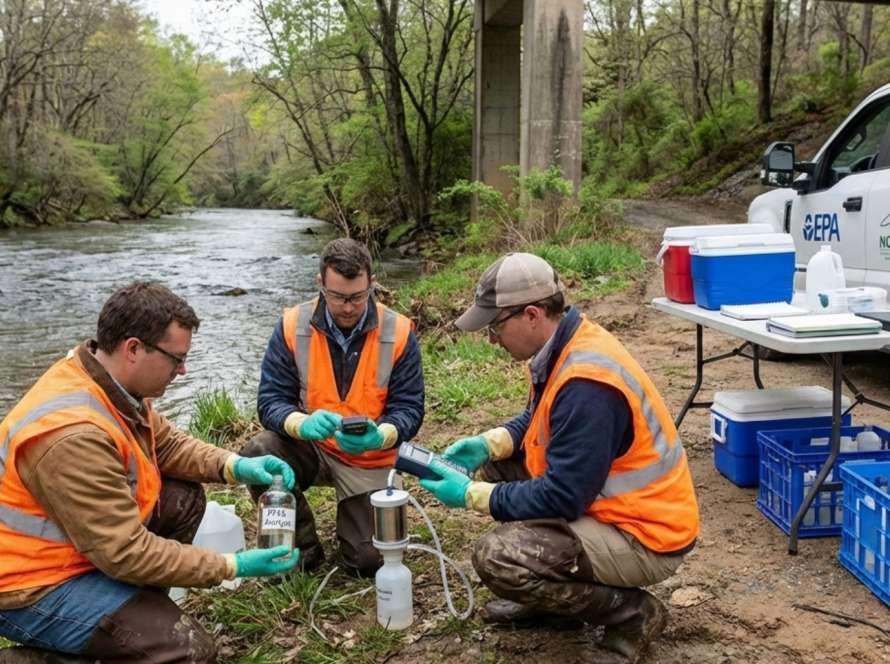
Across all environments, the system maintained high performance in both batch and continuous-flow conditions-an essential requirement for municipal water treatment facilities and industrial remediation systems.
From Capture to Destruction – Closing the PFAS Loop
Critically, the technology does not stop at PFAS capture. In collaboration with Rice professors Pedro Alvarez and James Tour, the team developed a thermal process that safely decomposes PFAS after adsorption.
When heated with calcium carbonate:
- More than half of the captured PFAS were destroyed
- No toxic by-products were released
- The LDH material was regenerated for reuse
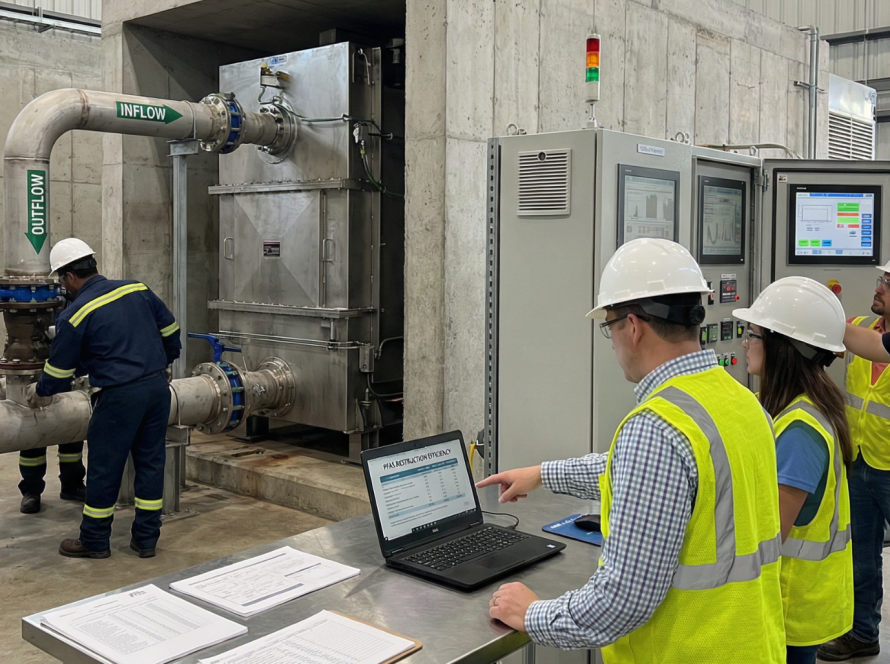
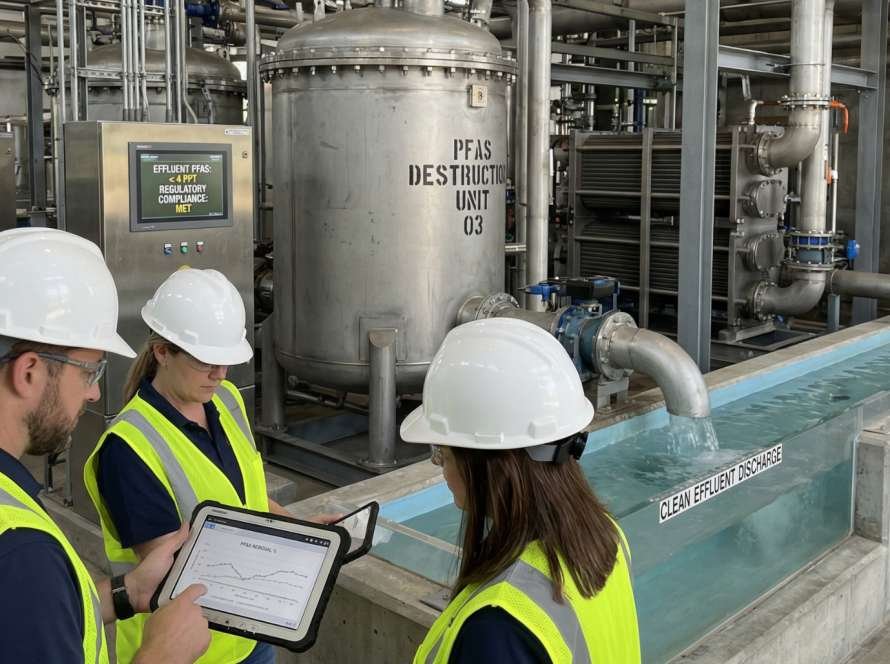
Early trials showed the material could complete at least six full capture–destruction–regeneration cycles, making it the first known closed-loop, reusable PFAS remediation system.
Why This Matters
For executives across utilities, infrastructure, chemicals, and public policy, this breakthrough addresses key unmet needs:
- Rapid PFAS removal at scale
- Elimination-not relocation-of toxic compounds
- Reduced long-term remediation costs
- Alignment with sustainability and regulatory mandates
As PFAS regulations tighten globally, solutions that combine speed, durability, and environmental safety will define the next generation of water treatment infrastructure.
Industrial-scale PFAS destruction technologies now moving beyond containment read more
Powered by Global Collaboration
The research was supported by funding from multiple international agencies, including scientific foundations in South Korea, U.S. federal research programs, and sustainability-focused institutes. The project highlights how cross-border collaboration and early-stage innovation can unlock scalable environmental solutions.