As regulatory pressure on per- and polyfluoroalkyl substances (PFAS) intensifies worldwide, industrial leaders are confronting a hard truth: traditional PFAS treatment methods are no longer sufficient. In 2026, the market is moving decisively away from “capture and contain” strategies toward verified, commercial-scale PFAS destruction.
For executives responsible for environmental compliance, operational risk, and long-term capital planning, this shift represents more than a technology upgrade-it marks a fundamental change in how PFAS liabilities are managed.
Why Containment Is Failing the PFAS Test
Granular activated carbon (GAC), ion exchange resins, membranes, and adsorbents have long been the industry standard for PFAS removal. While effective at separating PFAS from water, these technologies do not eliminate the chemicals. Instead, they concentrate PFAS into secondary waste streams that require transport, regeneration, incineration, or long-term storage.
As disposal pathways tighten and scrutiny increases, the downstream consequences of containment are becoming increasingly untenable:
- Escalating disposal and regeneration costs
- Regulatory exposure tied to PFAS-laden waste
- Growing litigation and reputational risk
- Long-term liability that remains unresolved
In short, captured PFAS is still PFAS-and it remains a problem.
The Industry Pivot: From PFAS Treatment to PFAS Elimination
Leading manufacturers are now prioritizing destruction at source. The rationale is straightforward: destroying PFAS before it leaves the facility removes both the chemical and the liability.
Commercial-scale PFAS destruction technologies now demonstrate the ability to permanently break down long-chain, short-chain, and ultra-short-chain PFAS compounds under real-world industrial conditions-not laboratory simulations.
This marks a critical inflection point for industrial wastewater strategy.
What Commercial-Scale PFAS Destruction Enables
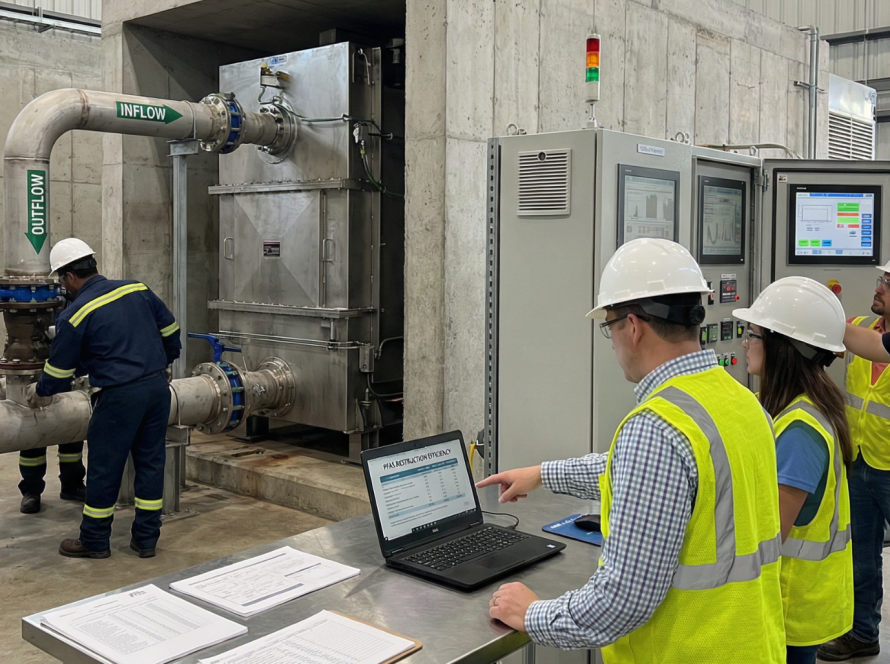
Advanced UV-photochemical systems now offer manufacturers a scalable alternative to disposal-dependent models. These systems are designed to integrate into existing industrial wastewater workflows and operate across a wide range of flow conditions.
Key performance outcomes include:
- Permanent destruction of up to 99.99% of targeted PFAS compounds
- Proven operation at hundreds of thousands of gallons per day
- Lower lifecycle costs compared with recurring capture and disposal
- Ambient temperature and pressure operation with compact footprints
- Elimination of secondary PFAS waste streams
For executive teams, this translates into predictable operating costs, reduced compliance exposure, and long-term risk mitigation.
Why Verification Matters: Data, Not Assumptions
In the PFAS landscape, claims without defensible data carry significant risk. Regulators, investors, and downstream stakeholders increasingly demand proof that PFAS has been destroyed-not simply transferred.
High-resolution analytical verification is now a critical component of PFAS strategy. Advanced measurement approaches, including total organofluorine analysis and high-resolution mass spectrometry, establish a clear before-and-after record of destruction across thousands of PFAS compounds.
This evidence-based approach creates a regulatory-grade audit trail, strengthening compliance positions and internal governance.
Regulatory and Commercial Advantages of Destroying PFAS at the Source
For industrial operators, PFAS destruction delivers strategic benefits beyond compliance:
1. Reduced Long-Term Liability
Eliminating PFAS before discharge avoids future exposure tied to disposal sites, incineration pathways, or waste transport chains.
2. Lower Total Cost of Ownership
By bypassing recurring media replacement, regeneration, and hazardous waste handling, facilities can significantly reduce operating expenses over time.
3. Simplified Compliance Pathways
Destruction-at-source minimizes permitting complexity and reduces scrutiny associated with PFAS-containing waste streams.
4. Stronger ESG and Risk Management Position
Verified elimination supports transparent environmental reporting and strengthens corporate credibility with regulators, investors, and communities.
2026: The Year PFAS Strategy Becomes a Boardroom Issue
As PFAS regulations expand and enforcement accelerates, passive treatment strategies expose organizations to mounting risk. In contrast, commercial-scale PFAS destruction aligns operational performance with regulatory reality.
For C-suite leaders, the choice is increasingly clear: continue managing PFAS as an ongoing liability-or eliminate it entirely.
Know about: Turning Point in the Fight Against PFAS Pollution
Executive Takeaway
PFAS destruction is no longer theoretical. In 2026, it is commercially proven, scalable, and increasingly essential. Organizations that adopt destruction-at-source solutions position themselves ahead of regulatory pressure, reduce long-term costs, and remove a critical environmental risk from their operations.The future of industrial PFAS management is not containment.
It is permanent elimination.