New York Expands PFAS Response With Updated Guidance, Data, and Regulatory Frameworks
New York State has announced a comprehensive set of actions to strengthen its response to per- and polyfluoroalkyl substances (PFAS), reflecting more than a decade of regulatory development and scientific investigation into these persistent chemicals.
The Department of Environmental Conservation has released a new progress report, finalized updated technical guidance, proposed additional policies for PFAS sampling and oversight, and launched a centralized public information portal to support transparency and stakeholder engagement. Collectively, the initiatives are designed to improve data quality, inform future regulation, and reduce exposure risks across water systems, soils, and consumer pathways.
A Decade of PFAS Policy Development
PFAS contamination was first identified in a New York public drinking water system in 2015. Since then, the state has steadily expanded regulatory controls, monitoring programs, and cleanup requirements.
Key milestones over the past decade include:
- Establishing enforceable drinking water standards for PFOA and PFOS
- Classifying PFOA and PFOS as hazardous substances for cleanup purposes
- Finalizing water quality guidance values for emerging contaminants
- Implementing restrictions on PFAS in products and biosolids recycling
- Expanding fish and wildlife monitoring and public consumption advisories
The newly released report consolidates these actions and outlines the state’s next phase of PFAS oversight.
Updated Guidance for Wastewater Treatment Facilities
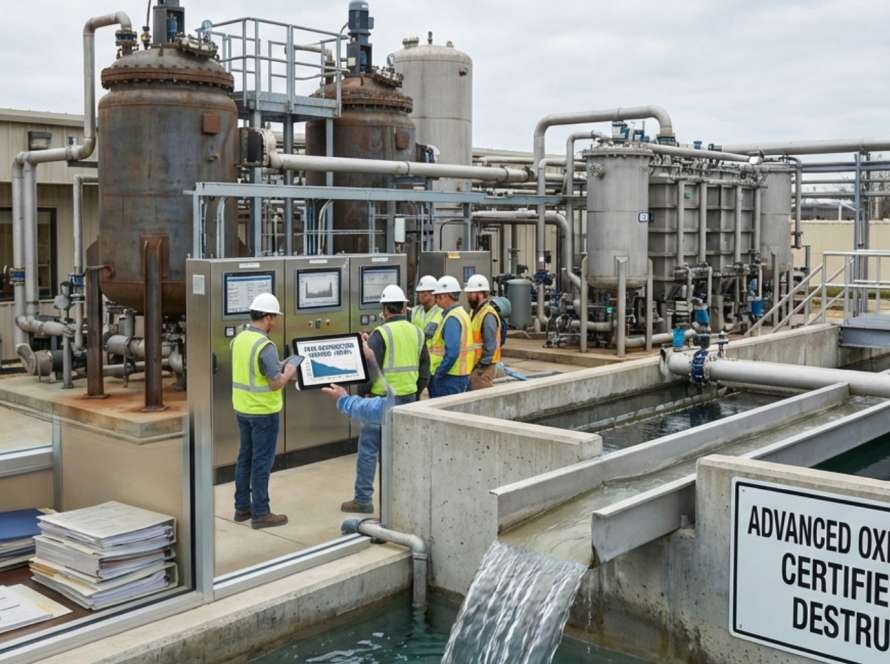
The Department of Environmental Conservation has finalized updated Technical and Operational Guidance Series documents for publicly owned wastewater treatment plants.
The guidance builds on prior requirements by expanding PFAS data collection and recommending upstream source identification programs. Because PFAS are widely present in consumer products and industrial inputs, complete removal at treatment facilities remains challenging. The updated framework emphasizes tracking contributors within communities and integrating compliance schedules into discharge permits.
To support transparency, the state has also made PFAS and 1,4-dioxane monitoring data publicly available through a centralized online portal.
Expanded Oversight of Biosolids and Soil Products
The state has proposed a draft policy requiring routine PFAS sampling and analysis of biosolid-derived soil products, including compost and heat-treated materials.
Biosolids are commonly reused as soil amendments, but PFAS concentrations within these products remain variable and incompletely characterized. The proposed policy would require permitted facilities and out-of-state suppliers to test products at certified laboratories and submit results to the state.
The collected data will inform future regulations establishing analytical thresholds and operational controls. Public comments on the proposal are open through January 9, 2026.
New Data on Background PFAS Levels in Rural Soils
New York has completed a statewide rural soil background study examining PFAS concentrations in areas without known industrial sources.
The findings indicate that PFAS are broadly present across the landscape. PFOS was detected in more than 97 percent of surface soil samples, while PFOA was detected in approximately 76 percent. These results are consistent with findings from neighboring states and will be used to inform future cleanup standards and remediation thresholds.
Revised Framework for Contaminated Drinking Water Assistance
The Department of Environmental Conservation has also proposed updates to its policy governing state assistance for contaminated water supplies.
The revisions acknowledge that PFAS contamination does not always originate from a single identifiable source. Potential contributors include wastewater, landfill leachate, septic systems, runoff, and atmospheric deposition.
The updated framework clarifies when and how the state will provide alternate water supplies, establishes procedures for defining areas of interest, and outlines criteria for implementing and discontinuing interim water solutions. Public comments on this proposal are open through February 10, 2026.
Investment and Long-Term Commitment
New York’s PFAS strategy is supported by significant public investment, including:
- Six billion dollars in water infrastructure funding since 2017
- One billion dollars annually in low-cost water infrastructure financing
- A 10-year, 1.25 billion dollar reauthorization of the State Superfund Program
- A new pilot program to support private well testing and remediation
These investments are intended to support cleanup, infrastructure upgrades, and long-term exposure reduction.
Additional Regulatory Activity and Public Resources
The state is continuing work to limit PFAS introduction through consumer products, including implementation of restrictions on PFAS in apparel. Draft regulations are expected in 2026 following stakeholder engagement and compliance testing.
To support public access to information, the state has launched a dedicated PFAS webpage that consolidates policies, studies, public comment opportunities, and educational resources into a single platform.
Key Takeaway
New York’s expanded PFAS response reflects a maturing regulatory framework focused on data-driven decision-making, lifecycle oversight, and long-term risk reduction. For executives in utilities, manufacturing, waste management, agriculture, chemicals, and real estate, the state’s approach highlights increasing expectations around PFAS monitoring, disclosure, and remediation.
As PFAS regulation continues to evolve at both state and federal levels, New York’s actions provide a reference point for how jurisdictions are integrating science, infrastructure investment, and regulatory enforcement to manage emerging environmental risks.